Entering a Threshold: Sculpture as Spatial Language
Rather than presenting the eye with objects it can easily resolve, Anish Kapoor fills the Hayward Gallery with spatial conditions that resist visual certainty. Gliding through the exhibition reveals that the sculptures themselves are only one part of the experience. The true material under investigation is perception. Kapoor’s work exists somewhere between architecture, sculpture and psychology. Objects refuse to remain objects. Walls become uncertain. Reflection no longer behaves as a mirror should and while visual obscurity becomes a tangible spatial condition. Rather than presenting sculpture as something to be observed, Kapoor proposes sculpture as an environment to be inhabited. The viewer becomes another element within the composition.
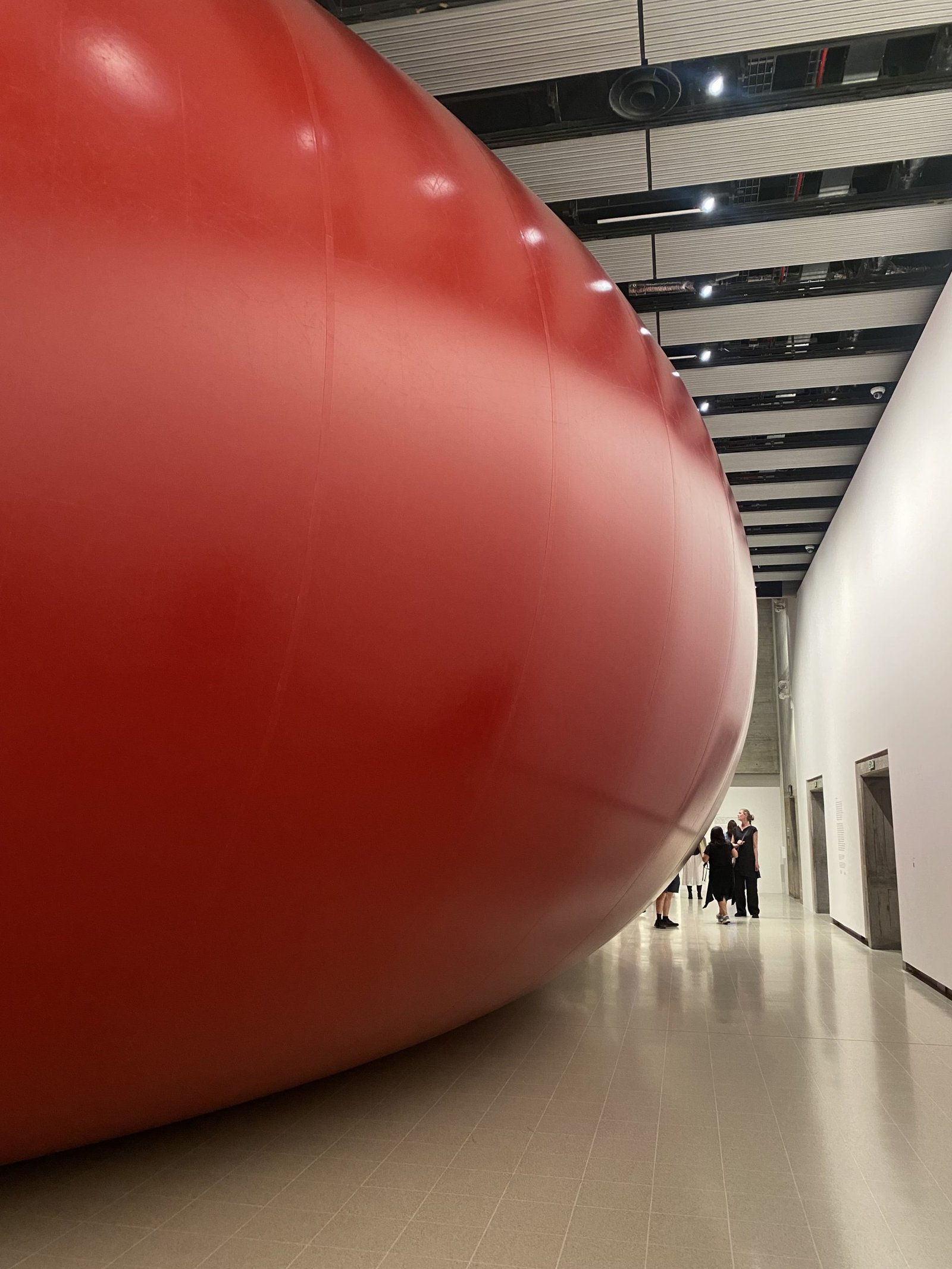
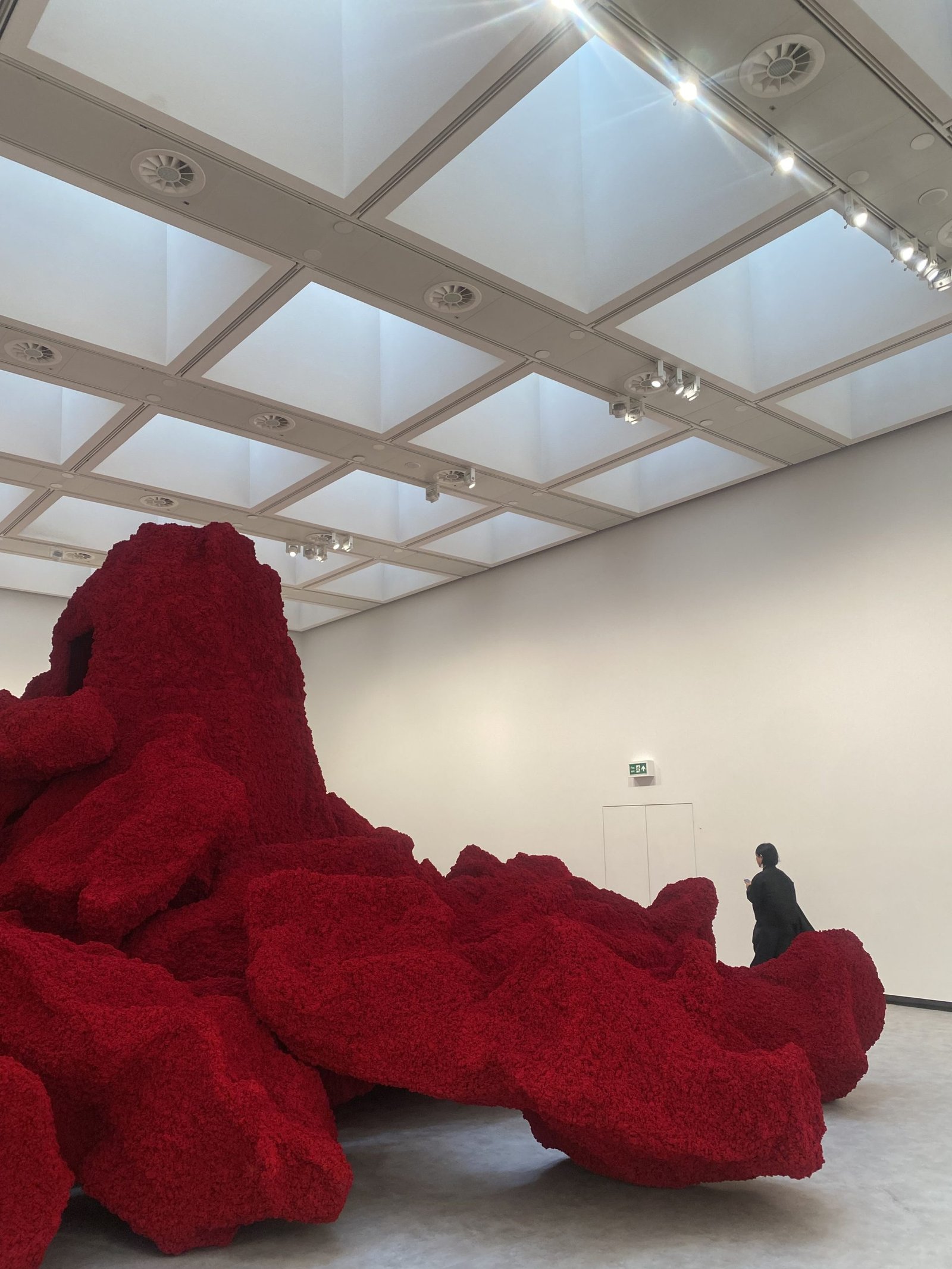
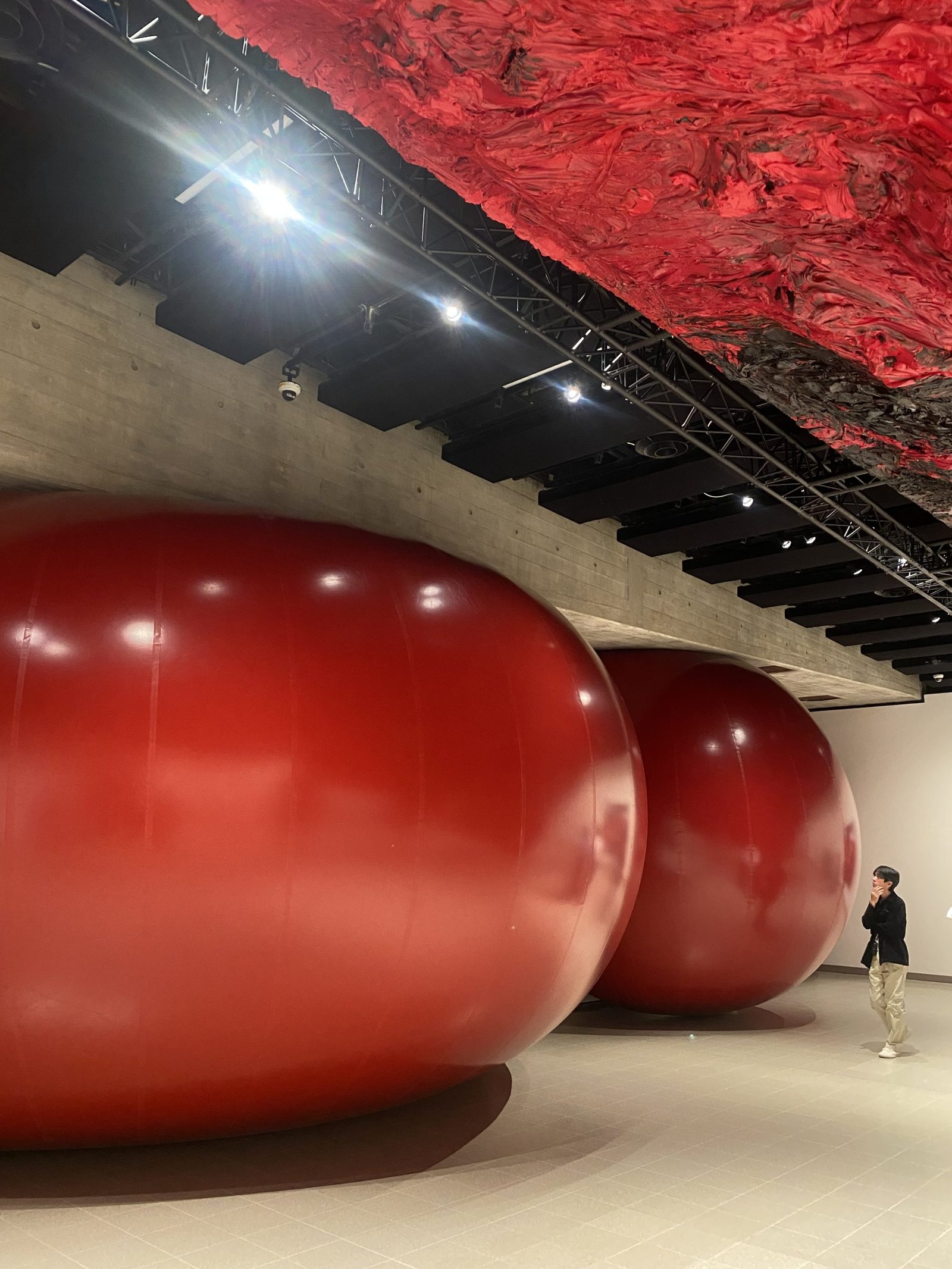
The exhibition is encountered less as a sequence of objects but rather as a series of spatial conditions. Forms are fluid. Pigments appear deeper than its physical surface. Vanatablack acquires illusions of volume. Openings refuse to reveal whether they are shallow voids or endless cavities. Vast sculptural forms press against the gallery walls and floors, while others descend from above, influencing the viewer’s sense of bodily position. Although the interior architecture remains unchanged, its surfaces begin to resist immediate comprehension.
Kapoor’s work repeatedly asks us to reconsider some of the most basic assumptions through which space is understood: where an object begins, where the surrounding room ends, whether a surface projects or recedes, and whether emptiness can possess a tangible presence. His sculptures and paintings are not only made to be seen. They create situations that must be entered, circled, approached and physically negotiated.
Sculpture Beyond the Object, The Gallery as an Instrument
Architecture has long been understood as the shaping of physical space. Kapoor extends this definition by suggesting that perception itself can become a building material. Throughout the exhibition the eye repeatedly attempts to measure depth, edge, scale and distance before immediately questioning its own conclusions. The gallery becomes more than a container. It functions as an instrument through which the sculptures produce pressure, scale, contrast and spatial doubt. The Hayward’s architecture is materially assertive. Its mass is visible. Its floors feel substantial, its walls possess weight, and its circulation is organised through a sequence of distinct chambers rather than one continuous neutral volume.
The building tells the body that it is secure, stable and measurable. The artwork suggests otherwise. This tension reveals that architecture is never perceived only through its physical dimensions. It is continually interpreted through vision, balance, memory and expectation. A room may be structurally unchanged while appearing psychologically expanded, compressed or destabilised. Kapoor’s works occupy this gap between physical fact and perceptual experience. The exhibition therefore transforms the gallery into a laboratory of spatial cognition. Each room tests a different relationship between material and perception. In one, reflection dissolves orientation. In another, texture removes the visual information required to understand depth. Elsewhere, scale overwhelms the body or a coloured form appears to push beyond its own material limits.
Kapoor has described some of these works as “non-objects”: forms that appear to hover between material presence and immaterial experience.
A polished steel sculpture can be materially solid while visually dispersing itself across the room. A Vantablack form may occupy measurable volume but appear almost entirely without surface. A void can be physically contained while appearing unlimited. Even when sculpture is abstract, it tends to maintain a clear distinction between itself and the space surrounding it. In architecture, a void is often defined by what surrounds it. A courtyard is shaped by walls. A room is produced through enclosure. A doorway becomes legible because of the structure around the opening. Kapoor reverses this hierarchy. The absence itself becomes primary, while the surrounding material operates as its frame.
One of the deeper questions raised by the exhibition concerns the way perception is developed. Seeing may feel instinctive, but much of spatial understanding is learned. We recognise a corner because we have encountered countless corners. We interpret shadows because experience has taught us how light behaves. We understand that floors support and openings lead somewhere because architecture has repeatedly confirmed those relationships. Kapoor disrupts this learned language. A surface that should reveal depth conceals it. A mirror that should confirm reality deforms it. An object that should possess visible volume appears flat. A cavity that is physically limited appears immeasurable. The viewer is promtped to reconsider the visual grammar through which space is normally read.
The work demonstrates that spatial experience is never generated by form alone. It emerges through the interaction of material, light, scale, memory, movement and the body. As artificial intelligence, adaptive materials, mixed reality and responsive environments continue to dissolve the boundary between the physical and the digital, architecture has an opportunity to evolve beyond the design of static objects into the orchestration of dynamic human experiences. The spaces of tomorrow may no longer be remembered for their form alone, but for the way they alter awareness, influence behaviour and quietly reshape our understanding of reality.
Perhaps the more profound implication is that this philosophy is not exclusive to architecture. It represents a methodology capable of extending across multiple creative disciplines, each concerned not simply with producing an outcome, but with shaping the way an individual perceives, interprets and emotionally responds to their surroundings.
Cinema has always understood perception as its primary material. Through sequencing, framing, sound, light and controlled revelation, directors construct psychological landscapes long before audiences consciously recognise them. Kapoor’s work operates in a remarkably similar way. His sculptures are not static compositions but carefully choreographed moments of anticipation, uncertainty and discovery. This relationship becomes increasingly relevant as physical environments begin to borrow methodologies from film.
Retail spaces, museums, hotels and public institutions are no longer designed as collections of rooms but as narrative sequences. Arrival, compression, release, concealment and revelation become cinematic devices translated into architecture. Space becomes story. The same philosophy is rapidly emerging within digital product design. User experience has traditionally focused on usability, efficiency and functionality, yet future interfaces may become increasingly concerned with perception, emotion and memory. Artificial intelligence allows digital environments to evolve in response to individual behaviour, creating interfaces that learn, anticipate and adapt. The experience is no longer standardised; it becomes personalised. Every interaction has the potential to reshape the next.
Under this lens, Kapoor’s work feels less like a collection of sculptures and more like an early prototype for a broader design philosophy. His practice proposes that material, light and form are only the visible components of a much larger system.
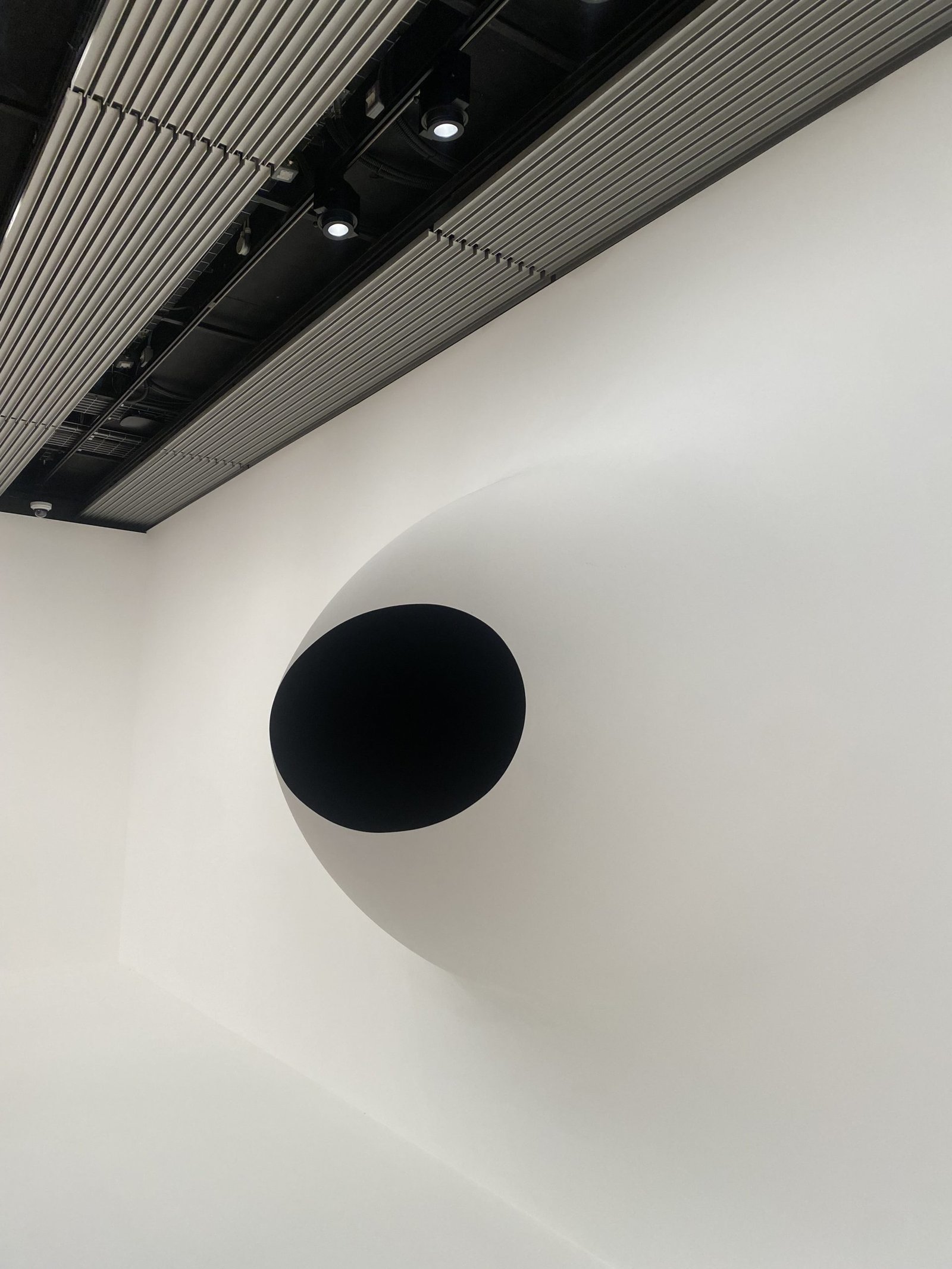
Vantablack as a Material Void
Kapoor’s voids expose the psychological contract between body and architecture. The sensation is produced by a breakdown in visual information. Depth usually depends upon gradients of light, visible texture, scale references and identifiable edges. When these signals disappear, the eye loses the ability to calculate distance. The body responds before the mind can resolve the image. This is why the void creates more than visual intrigue. It generates bodily tension. The visitor leans forward to understand it while instinctively maintaining distance. Attraction and caution operate simultaneously.
Vantablack is often described as the blackest material ever created, but within Kapoor’s work it operates as something far more significant than colour. It functions as a spatial instrument. By absorbing almost all visible light, Vantablack resists the visual information the eye depends upon to interpret form, depth and material presence. Rather than presenting an object to be observed, it constructs a perceptual condition that destabilises the act of seeing itself. Without reflected light, form becomes increasingly difficult to read. Curvature is flattened. Contour becomes uncertain. Texture disappears. What remains is not simply a black object, but a rupture in visual continuity.
Kapoor employs an engineered material to orchestrate an encounter with the unknowable. The eye understands objects because light establishes their boundaries. Highlights suggest projection, shadows reveal depth and subtle tonal variations communicate curvature. Vantablack systematically removes these visual cues, causing the object to detach itself from conventional spatial logic. The surface therefore generates far more than optical intrigue. It demonstrates that perception is not simply received but constructed. When visual evidence is deliberately withheld, the mind instinctively begins to speculate. The object may appear flat, hollow, infinitely deep or entirely without volume. None of these readings can be confirmed because the material refuses to provide the information necessary for certainty.
This relationship between advanced technology and metaphysical inquiry has become one of the defining characteristics of his practice. Although Vantablack originates from nanotechnology, its significance within the gallery lies not in scientific innovation, but in its capacity to transform a physical object into a perceptual absence. The material no longer communicates itself through visibility. Instead, it exposes the limits of vision itself. In Kapoor’s hands the material alters the relationship between object, space and perception.
Kapoor’s return to the Hayward Gallery is more than a retrospective; it is an exploration of perception as a design discipline. Across sculpture, architecture and material experimentation, the exhibition demonstrates that the most compelling environments are not necessarily those defined by their physical presence, but by their ability to reshape the way we see, think and inhabit space. Long after leaving the gallery, it is not the individual works that linger most vividly, but the subtle shift in awareness they produce—a reminder that design, at its most powerful, has the capacity to quietly transform our relationship with the world around us.
Anish Kapoor is on view at the Hayward Gallery, Southbank Centre, London, from 16 June until 18 October 2026. Whether approached through the lens of architecture, engineering, material innovation, psychology or contemporary art, the exhibition offers a rare opportunity to experience one of the defining creative voices of our time in a setting that is every bit as transformative as the works themselves. Tickets and further visitor information can be found via the Hayward Gallery’s official exhibition page.