The Correlating Language
Thoughts on Systems, Codes and Possibility
The Seed of Life becomes a surreal artefact through which an expanding system of ideas is given form. A machine reveals the mechanisms behind a system. A city turns a social condition into an inhabitable environment. The built enviroment landscape uses physical behaviour to generate architectural possibilities. These are not fixed categories, but different lenses through which the same question can be examined.
From this develops a series of correlating visual languages, each set across a different area of thought and experience. Some environments appear open and in constant motion; others feel locked, restricted or mechanically jammed. Together, they form an architectural research drawing series through which systems, codes and narratives can be studied not as isolated technical subjects, but as forces that shape how people move through society and what they are able to imagine and make of themselves within it.
What begins as an image develops into a way of thinking connecting personal experience to larger systems, physical mechanisms to social conditions, and the world as it exists to the worlds that might still be opened. Each connection adds another layer to an evolving structure, allowing individual observations, materials and ideas to inform one another rather than remain isolated. The aim is not to prescribe a single final answer, but to construct an open and adaptable framework one capable of being questioned, rearranged and expanded as new experiences, technologies and ways of seeing emerge. In this sense, the work remains deliberately unfinished: not incomplete, but alive to the possibility that each new discovery may alter how the whole system is understood.

South East London Origins: Reading the Present & Designing Beyond It
This is also an insight through the lens of being raised in South East London, gradually learning how to nurture a craft through architecture and design while getting to grips with the less visible ways in which the built environment is structured and developed. Long before I understood the formal language of planning, viability, regeneration or development, I understood the city through contrast. One street could feel protected while another appeared overlooked. Cross a road or enter a neighbouring borough and the scale, investment, architecture and sense of possibility could change. At the time, these differences were easier to feel than explain. Architecture eventually gave me the vocabulary and capacity to examine the instincts that had surfaced over time, while recognising that my perspective would continue to change with experience.
That understanding has not come from one type or scale of work. It has grown through actively working across residential projects, set design, construction management, public-space concepts and high-end developments each experience expanding what I understand a local environment to be. A local environment is more than a neighbourhood or physical site. It is the particular network of people, histories, resources, regulations, expectations and opportunities that shapes what can happen within it. Moving between these different contexts has revealed how every project responds to its own combination of conditions. The scale may change, but the fundamental challenge remains the same: understanding an idea and its surroundings well enough to help it become real.
No project overrules another. A residential extension can expose the intimate relationship between space and everyday life. A set can show how atmosphere, narrative and movement are constructed, even when the environment is temporary. Construction management reveals the coordination and practical decisions required to turn drawings into physical reality. Public-space concepts raise questions of access, collective use and who the city is being designed to serve. High-end developments demonstrate what becomes possible when ambition, specialist knowledge and resources are aligned. Each setting contributes a different part of the education. Together, they have changed how I read architecture not simply as a collection of buildings and spaces, but as a network of decisions with consequences for the people who occupy them. Design is influenced by policy, finance, time, narrative, negotiation and human need. Learning the craft therefore means learning to see both the visible outcome and the system operating behind it.
The images preserve more than a visual style. They register different stages of this developing awareness. Some capture moments when a condition could be sensed but not yet fully described; others show an instinct becoming a question, a question becoming a proposition and that proposition developing into a solution. They are markers of how my thinking has moved, where it paused and which ideas continued to return in another form. Looking back at them allows me to measure more than technical progress. They reveal changes in perspective: how my understanding of space has expanded from the building itself to the forces surrounding it, and from what is immediately visible to the codes, relationships and forms of permission that shape what can exist.
The drawings are therefore both architectural studies and entries in an ongoing journal. They hold the atmosphere of particular moments while leaving enough space for those moments to be reconsidered through later experiences. What appeared fixed in one image may be reopened in another. What began as a personal observation of South East London may eventually develop into a wider enquiry about access, systems and possibility. The lock emerges from this way of thinking. It gives physical form to a condition that could be felt long before it could be fully articulated: the sense that parts of the city and the lives imagined within them can appear open to some, restricted to others and governed by mechanisms that are not always immediately visible.

The Lock Reconsidered: An Apparatus for Enquiry and Imagination
The lock is never only about a building or a borough. It gives physical form to something that could be felt long before it could be fully articulated: the sense that certain places, opportunities and ways of living are opened to some while remaining restricted to others. Its mechanisms are not always visible, yet their effects can be recognised in the different ways people experience and move through life. That same lock is now being revisited, but no longer as a permanently sealed object. It is opened, dismantled and understood from within. This process is driven as much by curiosity as by the desire to find a solution. Rather than accepting the mechanism as fixed, the drawings ask how it was assembled, why its components operate as they do, who or what they were designed to serve, and how they might be rearranged to produce another outcome.
Opening the lock therefore becomes a creative exercise. Feeding the imagination does not mean inventing without reference. It means remaining receptive to the world and gathering material from different kinds of experiences. A detail noticed on a South East London street, a conversation on a construction site, the temporary atmosphere of a set, the behaviour of an unfamiliar material or the logic of a new technology can each contribute another component to the bigger picture. These observations may appear unrelated at first, but curiosity allows connections to form between them. One experience becomes a key for interpreting another, and an idea that begins in one context can be dismantled, adapted and rebuilt within another.
The lock develops through this accumulation. Its older components are not erased; they are cleaned, repaired and reconnected to new forms of intelligence. Their marks of use remain visible because they carry evidence of the conditions, decisions and lives that shaped them. New instruments are introduced, alongside them tools capable of reading patterns, recognising relationships and revealing possibilities that the original mechanism was not designed to consider. Technology expands the field of enquiry, but memory, experience and human judgement continue to give that enquiry direction.
What began as a symbol of restriction therefore becomes an apparatus for imagination. The lock is transformed into a workshop in which inherited systems can be examined without being treated as permanent. It suggests that curiosity is itself a way of gaining access: the willingness to look inside a condition, understand its individual parts and creatively reconnect them. In doing so, the drawing moves beyond representing what is closed and begins to explore what possiblities might still be opened or challenged

Intelligence as an Extension
This is where the image begins to speak to the present age of artificial intelligence. AI is often described as a bubble: a period of heightened attention that may eventually lose momentum. Yet I see something more fundamental taking place. Beneath the speculation is a genuine shift in how ideas can be explored, developed and communicated. The technology is still unfolding, and much of the anxiety surrounding it comes from not knowing where that process will lead. Its possible outcomes extend beyond what many people can presently imagine, and uncertainty is often easier to dismiss than to examine.
Every transformative tool arrives before society has fully developed the language, judgement or conventions needed to understand it. This creates a space between what the technology can already do and what we have learned to do with it responsibly. Within that space, excitement and fear often exist together. The question is therefore not simply whether AI is good or bad, or whether it will replace existing methods. The more useful question is how it can be shaped by human experience, directed towards meaningful enquiry and incorporated into a practice without allowing the tool to determine the practice itself.
AI does not remove the need for thought, experience or authorship. If anything, it makes these qualities more important. A system may generate countless variations, but it cannot independently decide which possibilities deserve attention, which carry cultural or personal meaning, or which respond intelligently to the conditions of a particular place. Those decisions still depend on the person directing the enquiry their memories, references, instincts, technical knowledge and understanding of the world. In this context, AI becomes less of a shortcut to a finished image and more of an extension of the imagination. It creates a responsive space in which systems can be disassembled, reconstructed and observed from positions that conventional representation may not easily reach. A building can be treated as a machine, a regulation can be translated into a physical obstacle, and a social condition can become an inhabitable world.
This changes the role of the author. Authorship is no longer located only in manually producing every visible component; it also exists in constructing the conditions through which a meaningful result can emerge. It lies in selecting references, developing prompts, rejecting generic outcomes, recognising unexpected value and repeatedly guiding the work towards a particular way of seeing. The value, then, is not in asking the technology to make the work fit within an existing visual trend. It lies in developing a language particular enough to make the technology respond differently to shape the process around a way of seeing rather than adjusting that way of seeing to the assumed limits of the tool.
Automation becomes most interesting when it is shaped by understanding, memory and intent. Its greater potential lies in helping us perceive connections that were present but previously difficult to articulate: between a personal memory and an urban system, between a hurdle and a social condition, or between an inherited mechanism and a future possibility. The intelligence of the work therefore does not belong to the machine alone. It emerges through an exchange between human curiosity and computational capacity. The machine can extend the field of vision, but experience gives that vision meaning. It can generate possibilities, but judgement determines which possibilities are worth pursuing. Used in this way, AI becomes another instrument within the creative process not a replacement for imagination, but a means of feeding it, challenging it and carrying it into territories that have not yet been fully drawn.

Different Codes, Different Outcomes
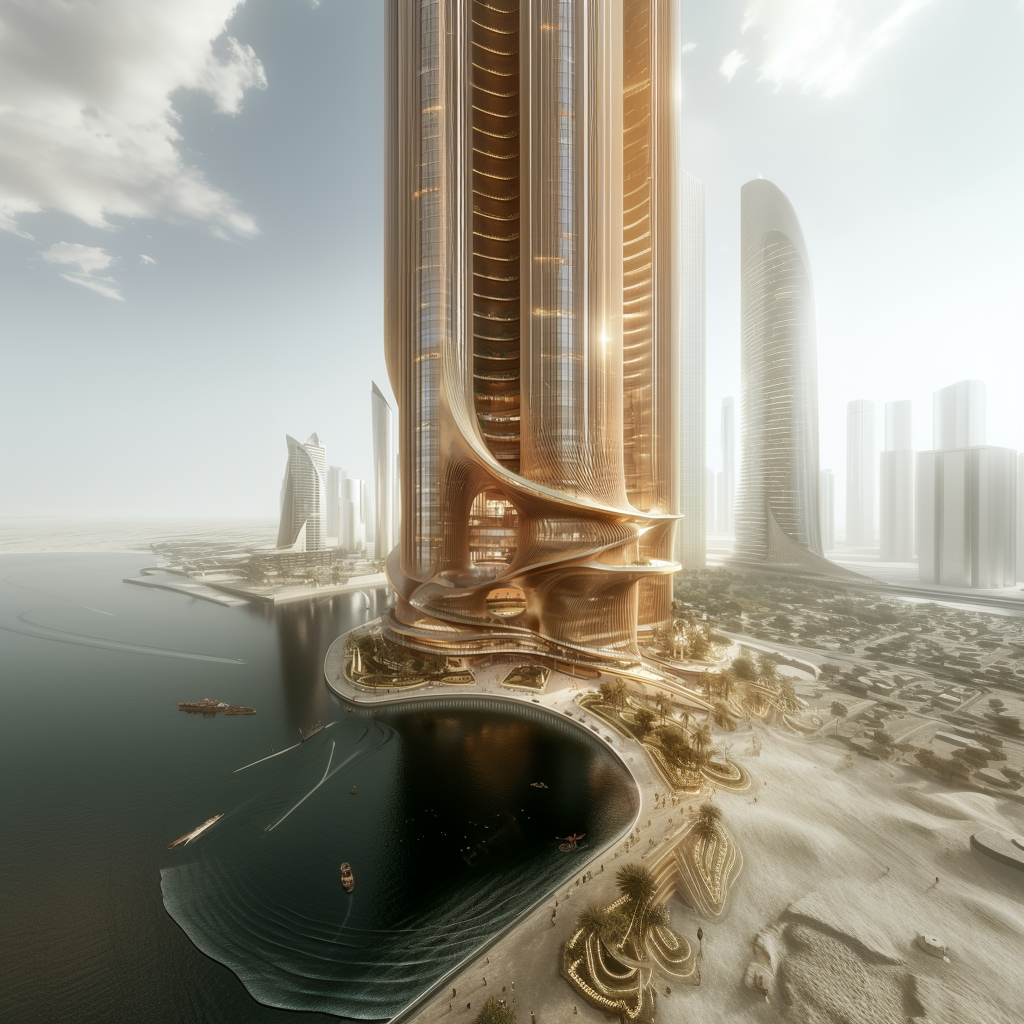
The surrealism lies in how familiar these imagined systems can feel. A mechanism may appear fixed in one place, while a short distance away the same pressures produce a different outcome. Sometimes that shift occurs across a road or at the edge of another borough, where context, policy, ambition and opportunity align differently. One environment may remain closely contained while another appears able to build higher, move faster or interpret its limits with greater flexibility.
This is not about placing one scale of development above another. Working across different levels makes the contrasts more visible and the lessons more useful. A domestic alteration can reveal as much about regulation, negotiation and human need as a major development. A set may exist temporarily yet demand an exact understanding of atmosphere, movement and construction. A high-end project may operate through different resources and expectations, but it remains dependent on coordination, detail and the ability to translate an idea into something buildable.
The difference is often not the value of the work, but the system surrounding it. Each environment has its own codes, thresholds and forms of permission. Learning to practise across them means learning how those languages correlate, where they diverge and which keys allow movement between them.

Image or Proposition: Beyond the Visible
A related thought passes through the material studies. This is where the distinction between an image and a proposition becomes important. The aim is not to use generative tools to simulate finished architecture or manufacture certainty. It is to create open-ended studies through which unfamiliar relationships can surface. A material reaction, distortion or apparent error may carry information that a controlled drawing would remove. The unexpected result becomes something to question, develop or resist.
These studies are therefore another record of thought in motion. One begins with a system, another with a narrative that needs to be developed and concluded through functional solutions, and another with a personal observation of the city. None is required to arrive at the same formal answer. What connects them is a willingness to look closely, identify the underlying condition and construct a language capable of thinking through it. Taken together, the system moves from where the story began, through the conditions that define the present, towards the worlds that may still be opened. Its purpose is not to produce finished visions of the future, but to construct visual arguments about the forces shaping it. The lock, the machine, the city, the experiment with an anchored narrative and the journey all ask the same question:
What governs the limits of possibility, and which keys allow us to move between them?